Showing posts with label learn. Show all posts

Saturday, September 28, 2013

Gaming improves multitasking skills


Gaming improves multitasking skills


Study reveals plasticity in age-related cognitive decline.
Sixty-five-year-old Ann Linsey was starting to worry about how easily she got distracted from whatever she was doing. “As you get older, it seems harder to do more things at once,” she says. Then she enrolled in a study to test whether playing a game could improve fading cognitive skills in older people — and was impressed by what it did for her. “I was frustrated because I felt I was losing my faculties. Now I’ve learnt how to focus my attention.”
Commercial companies have claimed for years that computer games can make the user smarter, but have been criticized for failing to show that improved skills in the game translate into better performance in daily life1. Now a study published this week in Nature2 — the one in which Linsey participated — convincingly shows that if a game is tailored to a precise cognitive deficit, in this case multitasking in older people, it can indeed be effective.
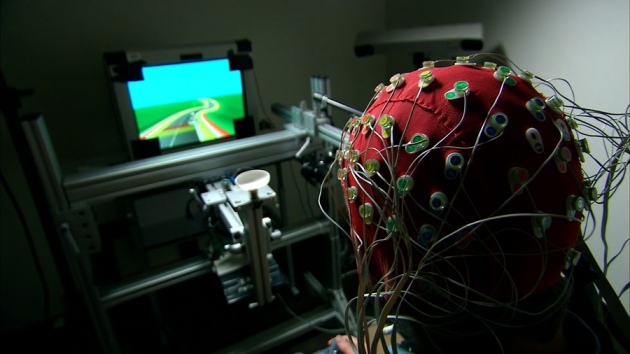
Led by neuroscientist Adam Gazzaley of the University of California, San Francisco, the study found that a game called NeuroRacer can help older people to improve their capacity to multitask — and the effect seems to carry over to tasks in everyday life and is still there after six months. The study also shows how patterns of brain activity change as those cognitive skills improve.
NeuroRacer is a three-dimensional video game in which players steer a car along a winding, hilly road with their left thumb, while keeping an eye out for signs that randomly pop up. If the sign is a particular shape and colour, players have to shoot it down using a finger on their right hand. This multitasking exercise, says Gazzaley, draws on a mix of cognitive skills just as real life does — such as attention focusing, task switching and working memory (the ability to temporarily hold multiple pieces of information in the mind).
Gazzaley and his colleagues first recruited around 30 participants for each of six decades of life, from the 20s to the 70s, and confirmed that multitasking skills as measured by the game deteriorated linearly with age. They then recruited 46 participants aged 60–85 and put them through a 4-week training period with a version of NeuroRacer that increased in difficulty as the player improved.
After training, subjects had improved so much that they achieved higher scores than untrained 20-year-olds, and the skill remained six months later without practice.
Improved mental skills that come from playing a video game are mirrored by increased brain activity.
GLOBE TV
The scientists also conducted a battery of cognitive tests on the participants before and after training. Certain cognitive abilities that were not specifically targeted by the game improved and remained improved — such as working memory and sustained attention. Both skills are important for daily tasks, from reading a newspaper to cooking a meal.
That is significant, says Gazzaley. “Neuro­Racer doesn’t demand too much of those particular abilities — so it appears that the multitasking challenge may put pressure on the entire cognitive control system, raising the level of all of its components.”

Gaming improves multitasking skills

Study reveals plasticity in age-related cognitive decline.
The team also recorded brain activity using electroencephalography while participants played NeuroRacer. As their skills increased, so did activity in the prefrontal cortex of the brain, which is associated with cognitive control, in a manner that correlated with improvements in sustained-attention tasks. Activity also increased in a neural network linking the prefrontal cortex with the back of the brain.
The industry that has grown around selling brain-training computer games has polarized opinion about the effectiveness of brain-training packages, says cognitive neuro­scientist Torkel Klingberg of the Karolinska Institute in Stockholm. “Some companies are not based on real science, and have made un­realistic claims,” he says. “On the other hand, some psychologists have claimed that working memory and attention are fixed and can’t be trained up.”
But Gazzaley’s study confirms that cognitive function can be improved — if you design training methods properly, says Klingberg, who is a consultant for Cogmed, a company he founded in 1999 to market computer-based training methods, particularly for people with attention-deficit disorders3.
Last year, Gazzaley also co-founded a company, called Akili, for which he is an adviser. It is developing a commercial product similar to NeuroRacer, which remains a research tool, and will seek approval from the US Food and Drug Administration to market it as a therapeutic agent. A ‘games’ approach might also help people with particular cognitive deficits, such as depression or schizophrenia, adds Daphne Bavelier, a cognitive neuroscientist at the University of Geneva in Switzerland, who develops computer games to improve brain function and who also advises Akili.
Gazzaley cautions against over-hyping: “Video games shouldn’t now be seen as a guaranteed panacea.” But Linsey, for her part, is happy with what the game did for her and about her own contribution. “It’s been exciting to discover the older brain can learn — and I’m glad my own brain helped make the discovery.”
Nature
 
501,
 
18
 
()
 
doi:10.1038/501018a


http://www.nature.com/news/gaming-improves-multitasking-skills-1.13674

Thursday, September 26, 2013

5th Virtual Conference on Counseling Nov. 20-22, 2013


5th VIRTUAL CONFERENCE ON COUNSELING (5VCC)
November 20-22, 2013
CESL Conference Center, Second life

About the conference:
5VCC is an opportunity for Counselors, Counselor Educators, and allied professional to present on topics of their interest to an international audience. The conference is hosted in a virtual environment (Second Life) and this allows presenters and attendees to attend the conference at minimal cost and disruption. Continuing Education Credits will be available for attendees.

Call for Proposals:
Each presentation slot is 50 minutes. You can submit a conference proposal here
Registration:
In order to participate in 5VCC you must have 1. a (free) registered account with Second Life (go to SecondLife.com and Join), 2. You should have downloaded and setup the Second Life (free) viewer software (http://secondlife.com/downloads), and 3. Logged in with your avatar name through the viewer software.Register (free) for the conference will become available soon. 

Counselor Education in Second Life is pleased to be working again this year with 
Onlinevents.co.uk who will be webstreaming the conference at their site for those unable to join the conference through Second Life avatars.
We had so much success with last year’s counseling conference that we are going to try to expand it this year to include a wider range of clinicians and scholars from around the globe. This opportunity to share and learn with interested individuals worldwide is just one of the strengths of presenting and attending this conference.

This conference provides a vehicle for you to share your knowledge and experience with interested attendees without the time or expense of travel.  For those unfamiliar with Second Life and wanting to experience presenting in this environment full training will be provided.  Mastering a new technology can be intimidating yet the conference coordinators have developed training methods to help any interested party successfully deliver dynamic and engaging presentations for this conference.


Presenting in a virtual environment such as Second Life allows for presentations that are as simple as a PowerPoint or as complex as a 3 dimensional immersion in a topic. This medium offers an opportunity to stretch your creativity on your topic.

Wednesday, September 25, 2013

SLACTIONS 2013- Learn more


SLACTIONS 2013
Research conference on virtual worlds - Learning with simulations: 21-23 November, 2013
Slactions 2013 is the fifth edition of SLACTIONS, the original international conference held 
simultaneously in several countries on the topic of virtual worlds and metaverse platforms. This
 edition initiates a cooperation with the VS-GAMES conference, on the form of the 
The 2013 edition includes the theme “Learning with simulations”. Special panels/
workshops will convey this theme. The use of simulations in learning is now an 
important field of research in education and professional development, and 
virtual worlds/metaverse platforms play a significant role in this context. So join 
us for Slactions 2013, for the fora where researchers can present and discuss 
developments in simulations aiming to assist learning in science and technology 
education.
Virtual worlds and metaverse platforms have evolved from their text-only MUD origins to 
fully graphic massive locales, such as World of Warcraft, Lord of the Rings Online, Second Life, Minecraft, Habbo Hotel, IMVU, League of Legends, and many others. Alongside these ready-to-use environments, many technological 
platforms support do-it-yourself creation of virtual worlds, such as OpenSimulator, Open 
Cobalt, Open Wonderland, and more. Social media has recently also presented itself as a 
channel for virtual worlds such as Cloud Party or The Sims Social.
This increasing use of virtual world technologies that act as platforms for end-users to 
create, develop, and interact, is expanding the realm of human cooperation, interaction, 
and creativity. Slactions is looking to present selections from submitted research, focusing on
 both basic research and applications of the aforementioned metaverse platforms and others, including MMORPGs and social media virtual worlds, providing a forum for the research community to present and discuss innovative approaches, techniques, processes, and research results. Multiple disciplines meet at Slactions, enabling a global perspective on 
research topics and concerns: Slactions has been contributing to the creation of a 
worldwide research community of virtual worlds / metaverse researchers. Slactions unique in its format too, as an event conducted both in a metaverse platform and on-site in multiple countries throughout the world. It contributed to 
the current redefinition of the way we think about hybrid online and on-site scholarly 
collaborations.
Format
Slactions has the format of a hybrid online and physical conference. All paper presentations
 and plenary sessions by guest speakers will be held in an online virtual world (instrucions will 
be provided in the conference website), and projected locally at local chapters, for 
participants attending physically. Physical participants can interact with the online 
participants via a “physical chapter avatar” and microphone.
Workshops and other events may also take place locally in specific chapters or in mixed 
format across several participating chapter


Tuesday, September 24, 2013

Immersive Information Environments" in Second Life


 SJSU Virtual Worlds Colloquia   Ran Hinrichs, CEO of 2b3d, an immersive web solutions company, and on faculty at the University of Washington's iSchool, will present a virtual worlds colloquia on "Immersive Information Environments" in Second Life at the SJSU SLIS campus on Tuesday, September 24, at 6 pm pacific.  VirtualWorlds are blending into a broader field known as Immersive Information Environments in which the 3D features of virtual worlds combine with the immersive features of computer mediated communication and collaboration technologies to bring people together in various venues: conferences, classes, clinical sessions, coaching, etc.  Participating in a virtual world is not passive.  It requires immersive communication skills and interpersonal relationships for it to be effective.  Ran has been in the software industry for twenty-five years with positions in Microsoft, Microsoft Research, Sun Microsystems, Unisys and the University of California.  He has several patents in learning science and data
His new book, The Oxford Handbook of Virtuality, is due out in 2014. Ran teaches Immersive Information Environments all in virtual environments.
SLURL for program:  SJSU SLIS (39,74,33)

Thursday, September 19, 2013


Feminist Digital Initiative Challenges Universities’ Race for MOOCs
Columbus, OH, August 21, 2013: FemTechNet, a network of feminist scholars and educators, is launching a new model for online learning at 15 higher education institutions this fall. The DOCC, or Distributed Open Collaborative Course, is a new approach to collaborative learning and an alternative to MOOCs, the massive open online course model that proponents claim will radicalize twenty-first century higher education.

The DOCC model is not based on centralized pedagogy by a single “expert” faculty, nor on the economic interests of a particular institution. Instead, the DOCC recognizes, and is built on, expertise distributed among participants in diverse institutional contexts. The organization of a DOCC emphasizes learning collaboratively in a digital age and avoids reproducing pedagogical techniques that conceive of the student as a passive listener. A DOCC allows for the active participation of all kinds of learners and for the extension of classroom experience beyond the walls, physical or virtual, of a single institution. FemTechNet’s first DOCC course, “Dialogues in Feminism and Technology,” will launch fall 2013.

The participating institutions range from small liberal arts colleges to major research institutions. They include: Bowling Green University, Brown University, California Polytechnic State University, Colby-Sawyer College, CUNY, Macaulay Honors College and Lehman College (CUNY), The New School, Ohio State University, Ontario College of Art and Design, Pennsylvania State University, Pitzer College, Rutgers University, University of California San Diego, University of Illinois Urbana-Champaign and Yale University.

DOCC participants, both online and in residence, are part of individualized “NODAL courses” within the network. Each institution’s faculty configures its own course within its specific educational setting. Both faculty and students will share ideas, resources, and assignments as a feminist network: the faculty as they develop curricula and deliver the course in real time; the students as they work collaboratively with faculty and each other.

At Ohio State, the course will be taught in the Women’s, Gender, and Sexuality Studies by Dr. Christine (Cricket) Keating. The course, “Gender, Media, and New Technologies,” will be offered on the undergraduate level. Keating is a recipient of the 2011 Alumni Award for Distinguished Teaching.  This course takes as its starting point the following questions: How are gender identities constituted in technologically mediated environments? How have cyberfeminists used technology to build coalitions and unite people across diverse contexts? How are the “do it yourself” and “do it with others” ethics in technology cultures central to feminist politics? Juxtaposing theoretical considerations and case studies, course topics include: identity and subjectivity; technological activism; gender, race and sexualities; place; labor; ethics; and the transformative potentials of new technologies. The course itself is a part of a cutting-edge experiment in education, culture, and technology. It is “nodal” course within a Distributed Online Collaborative Course (DOCC). In this course, we will collaborate with students and professors across the U.S. and Canada to investigate issues of gender, race, and techno-culture.

These dialogues are also anchored by video curriculum produced by FemTechNet. “Dialogues on Feminism and Technology” are currently twelve recorded video dialogues featuring pairs of scholars and artists from around the world who think and reimagine technology through a feminist lens. Participants in the DOCC — indeed, anyone with a connection to the web — can access the video dialogues, and are invited to discuss them by means of blogs, voicethreads and other electronic media. Even as the course takes place, students and teachers can plug in and join the conversation.  Through the exchanges and participants’ input, course content for the DOCC will continue to grow. From this process emerges a dynamic and self-reflective educational model.

http://maps.secondlife.com/secondlife/Minerva%20OSU/134/100/29